Where can water funds – user investments to protect upstream watersheds and sources – benefit conservation, sustainable economic growth, and human well-being?
As human populations grow, cities experience water quality and quantity issues. However, governments, corporations, and multilateral banks often rely on building costly infrastructure, such as dams and reservoirs, to solve these problems instead of investing in natural ways to secure clean water and mitigate flood risk. These key actors often have knowledge and tools to quantify expected gains from engineered solutions, but tend to lack information they need to understand how natural solutions, such as watershed protection, can enhance water security.
OUR APPROACH: This working group explored costs of urban water security and developed tools for key stakeholders to evaluate water quality risk, watershed conservation solutions, and flood mitigation in Latin American cities. Using this group’s work, decision makers can get a better idea of how to maximize returns on major nature-based investments for water security.
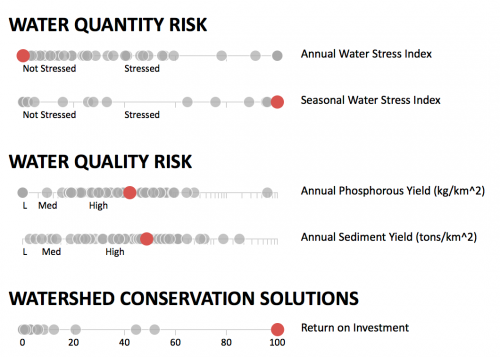
This interactive dashboard allows key stakeholders, such as the Latin American Conservation Council and Inter-American Development Bank, to explore urban water source risks and beneficial conservation efforts. The tool provides metrics for population, water quantity flood mitigation, water quality riparian restoration, and reforestation. The resulting analysis and comparisons will help policymakers evaluate the strengths and limitations of watershed strategies in major Latin American cities. Of all cities included in the dashboard, the city of Bucaramanga had the highest potential return on investment (ROI) for watershed conservation, as shown in the image to the right.
This online tool allows users to quickly measure the potential for five common watershed conservation activities to reduce sediment and nutrient pollution in a source watershed. This tool will describe land cover and estimate pollutant loading for each source watershed. It will also show the amount of conservation effort (in area or cost) needed to achieve a 1%, 5%, 10%, and 20% pollution reduction.
Impacts
“Nature is a cost-effective solution for 17 out of 64 major cities in Latin America; 60 million people could potentially benefit. These are arguably a slam dunk – a strong business case for nature regardless of other benefits that nature provides.”